Friday, January 15, 2010

Sewing Tutorials

It's fantastic how the www works, really.  Until about 5 years ago I used to sew in solitary splendor although obviously I knew there were others out there.  Then I joined PatternReview and started reading blogs.  Over time, I came to realize that through communication on the internet, I had improved my sewing and been introduced to a whole lot of new sewing information and resources. 

Among which are on-line sewing tutorials.  The best collection of them that I know of can be found on Sigrid's blog. I was thrilled when Sigrid contacted me to ask if she could include a few of my own photo-tutorials on her site.  In future I'll post tutorials on this blog as they occur to me.  For now, here's a list of the ones I've prepared and links to Flickr where you can read through them.  Enjoy!  If you have any questions about these techniques, feel free to ask. 

Faced fly front zipper.  This is one of those construction methods that looks like it is impossible.  But it is not! 


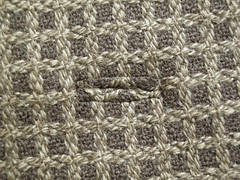
Bound buttonholes.  The method I illustrated is actually overkill - you don't need to sew all those parallel basting lines because once you sew around the box and slash the opening, cutting right to the corners, the patch forms perfect "lips" when it wraps over the cut edges. 

I'm going to be making bound buttonholes in my plaid jacket and will update the tutorial then. 


Beltloops.  This method doesn't rely on remembering to sew one end of the loop into the waistband (I always forget to do this!), and it doesn't require topstitching the loop to the garment - all attaching stitches are concealed and there are no raw edges.  More magic!


Bellows patch pocket.  I made this tutorial to translate Burda's somewhat incoherent instructions into something understandable.  The bellows are decorative on my linen jacket, but this technique would work for real cargo pockets as well. 


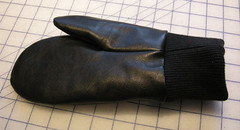
Leather mittens.  Mittens are sooo much warmer than gloves, and leather mittens are windproof and look nice too.  These are made from an old leather skirt found in a thrift shop.  The tutorial includes a birds-eye view of my pattern as well as all construction techniques.


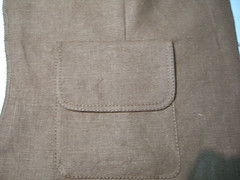
Lined pocket flaps.  This is another technique I'll use on my plaid jacket.  To reduce bulk, use lining fabric to face the flap, and to ensure the edges are hidden, make sure the lining layer is slightly smaller than the outer flap.  The seams will roll automatically to the wrong side. 

Fakes and Forgeries

The Associated Press reported in today's NY Times that Italian authorities last year recovered thousands of looted art and antiquities valued at close to $240 million US dollars. The story said: "Police figures show the number of illegal archaeological excavations discovered in 2009 decreased dramatically, from 238 in 2008 to just 58 in 2009. But at the same time, the number of people charged with falsifying artwork rose more than 400 percent."

The fact is that forged art exists in the marketplace, and this newspaper report serves as a caution to stay alert. Authenticating artwork is an essential component to ethical collecting. One should take time to ensure that a piece is not just looted or illegally exported, but that it is genuine.

Legal Tools for Artists

The Carving Studio in Vermont is holding a workshop in July. It is titled Legal Tools for Artists. Go to the link at carvingstudio.org/workshops/courses.asp

Wednesday, January 13, 2010

Family Plot (1976) Directed by Alfred Hitchcock


Nick:
Hitchcock's last film is not highly rated. Often dismissed as a gentle
suspense
it's without doubt the least celebrated film of his latter years.
What struck me
watching Family Plot for the first time was how the two
separate
stories about two different couples whose paths eventually cross
with
potentially deathly results looks initially so un-cinematic. The
first hour
or so comes across as an average episode of 1970's detective
series Columbo.

Then something happens, notably a crazy car ride without any brakes on a
winding mountain road (this scene a nod to Cary Grant's drunk drive in
North By Northwest).
This finally demonstrates Hitchcock's classic use of
high wire suspense and
humor. From then on the film is a tense blast, with
Hitchcock once again
referencing himself with a shot of Barbara Harris in
distress that recalls the
shower scene in Psycho.
The performances from the four central actors are
excellent with Bruce
Dern and Harris as out of work actors looking to get
by as a taxi driver
and psychic (!) really shining. Their relationship is
portrayed with a
natural West Coast vibe spiced with lots of witty
British sexy innuendo.
Special mention to Karen Black who dons a blond
wig to portray the almost
quintessential 'femme fatale'.
In other words, eventually, this movie was
fun.

Astrid:
I feel sympathetic towards Hitchcock.He became old and ill and knew
exactly how a movie should be done, but the world kept
changing as if it forgot about the aesthetics of Psycho, Birds,

Vertigo, Rear Window or all the others. In Family Plot I see a

director adjusting to the 1970s. There is the slow pace,
the
not-so-well-educated couple who talk about sex and

want to eat more than one hamburger while conning
a rich
old lady. And their clothes are casual, suits greased and lilac in shade.
This is the fun 'contemporary' side of the film.

Then there are the almost obligatory upper class diamond
thieves.
A couple that stylistically represent
the classic Hitchcock view, I think.
Karen Black's
blond wig disguise makes her at times the usual femme fatale.
Yet, the fact that she is seen switching
to her own brunette hair in the
couple's car (more than
once) feels almost as if the director peeling his
away his own cinematic fixations.


At times I was exhausted and bored by the predictability of this film.
But in the end
its sympathetic qualities have won me over.


Tuesday, January 12, 2010

The Age of Innocence (1993) Directed by Martin Scorsese & Remains of The Day (1993) Directed by James Ivory


Astrid:
When I was a teenager I believed that love conquers all social settings
and rules. Back then watching The Age of Innocence was like
witnessing idiots wasting their lives away –– angering and frustrating.
Now I've become a fan of the endless reserve. Both The Age of
Innocence and Remains of The Day are two-hour defenses for
the sexiness of reserve. Anthony Hopkins (in Remains...)
and Daniel Day-Lewis (in The Age...) play their very different
approaches to inexpressible love with excellence. Incidentally,
both movies portray women as weaker and more prone to protest
against social order.

Still, there is something completely distancing and unattached in
both movies, but especially in The Age of Innocence.
The camera lingers on plates of exquisite upper-class food arrangements
one too many times; often it feels that the director doesn't trust
Edith Warton's dry cynicism to carry the movie and he compensates
with too many awe-inspiring shots of velvety interiors.
And by now it should be official: Winona Ryder is simply boring as
an actor and Michelle Pfeiffer is not much better than that.
What was going on in the 1990s casting in Hollywood?

Nick:
1993 must have been a big year for period drama. Arguably the kings of
the period drama genre in modern times were director
Ivory and his
producer partner Ismail Merchant.
Just a little perusal through their
work gives you a rough idea
of the kind of films they made (i.e.Howards
End, Maurice, A Room With
A View etc). What you normally get in an
Ivory/Merchant film is lots of stiff
upper lip and wonderful costumes.
This story of unfulfilled desire
that the mansion Butler Stevens (played
by an excellent Anthony
Hopkins)feels for the mansion Houskeeper (Emma
Thompson)
is a slight film where etiquette often trumps emotion.

Altman's Gosford Park is a more entertaining film based on a similar
occupation.

Scorsese comes really unstuck on his adaptation of Edith
Wharton's Age
Of Innocence. Not only is Scorsese more interested
in the cutlery,
flowers, artwork, clothing and general period detail
that populate the
lives of these characters, he leaves us not really
caring for them. The
opulence of these upper class 19th Century
New Yorkers is not so
engaging and so little else is on offer.
Daniel-Day Lewis is superb as
lawyer Newland Archer, unfortunately
Michelle Pfeiffer and Winona Ryder
are awful and out of their depth
as the women in Archer's life. The film
looks amazing and is technically
as good as it gets but the over all
effect is so what
and so cold, cold cold.


Monday, January 11, 2010

Watchmen 2009 (Directed by Zack Snyder)


Nick:
Film adaptations of classic books are always tricky. Film adaptations of
classic Graphic Novels and this being the Holy Grail of Graphic Novels,
adapting Alan Moore's truly fantastic story to the big screen was always
going to be hard. As a comic book fan, Watchmen is a personal favorite
so my interest in the film is high. It's amazing that with Snyder's past
as a film maker (300, Dawn Of The Dead) he succeeds with Watchmen
on some levels.

This was my second outing with Watchmen. I caught it on the big
screen last year and was slightly blown away by the visuals
and the overall feel of the film. Watching the film at home the
visuals once again impressed and with the time to really take in
some of the scenes it's obvious that Watchmen looks as good as
anything out there. The death of the Comedian, the credits sequence
charting the rise of the Minutemen through to the creation of
Watchmen time lined by historical events against a musical backdrop
of Dylan's The Times They are a Changing and the story of
Dr. Manhattan's creation to super human being are all
mighty impressive.

Moore's story works on many levels and stripping
back some of the major plots from the novel has created a film that
feels disjointed. The politics of the source have been simplified for
mainstream audiences (obviously a commercial consideration for
Snyder and the kind of budget he was dealing with).
The sex presented within the film is clumsy and verging on the soft
porn variety at times. As expected, the violence is hard and at the
same time glamorous. Moore's book deals not only with
gender issues but particularly how women are dealt with within the
super hero fraternity and the pure fetishistic thrill of pulling on a
rubber costume and administering justice. It's also a book about
identity and human nature. What Snyder serves up is a story about
men in tights and women in stockings (and not much else!) trying to
save the world from Nuclear destruction. That he makes it this
simplistic and it still trumps most comic book adaptations is an
achievement even if Snyders' re-writing of the ending is a little too
convenient to convince.

On the downside the casting is a major problem. Malin
Ackerman (Silk Spectre II), Billy Cudrup (Dr. Manhattan) &
Matthew Goode (Adrien Veidt) really don't cut it in their roles.
Yes, Ackerman looks great in and out of her costume, but boy is
she bad at delivering lines. You don't really believe that DR.
Manhattan would consider saving the world for this bimbo!
The women in Moore's book just come across smarter than this.
However Jackie Earle Haley makes the Rorschach character
his own and gives the film it's soul.
In fact, Rorschach is wonderful in Watchmen and worth the
effort alone. A director's cut (apparently a 4 hour plus version
with those missing plot lines) is coming this year.
Still, a valiant attempt at bringing some complex issues and
themes to a mainstream audience.

Astrid:
Ok, I have been pressured to watch this movie. I have heard
plenty of monologues on how great it was in the cinema.
I have heard that there will be a 5-hour-version of
the film coming out this year.
I have been told repeatedly to read the book. The Graphic
Novel, not a comic.

I found myself oddly entertained by this movie. Despite
the awful acting, the awkward jumping from scene to scene,
and the violence that made me turn my head away from the
screen. The look of the film was pleasing in its grimness.
The 1980s style and the freedom of style which seems to come
with adaptations of comics/graphic novels were almost inspiring
to me.

But why the awful void in the content, when obviously
the original material has grappled with some fascinating
questions about the universe, physics, and human nature?
My favorite character Doctor Manhattan has been a human
being, but through a physics lab-accident he has turned into
someone who can dismantle his molecular structure and travel
thus in time and place. He is a fascinating what-if character
who holds many powers associated only with god. He has
been used as a weapon by the US government, he is
supposed to save the world from nuclear war as well.
But as Doctor Manhattan is not a human anymore, he has
become too distant from humanity, from emotions.
He is unattached to life for its own sake. For a while he sees
nuclear disaster and the extinction of humanity as not such
a bad thing. All this is great. I respect anyone pondering
on such questions, and using their creativity and imagination
to ask questions about our future/past/present.

Unfortunately, the movie had to also be an entertaining
piece of action, so it could not focus only
on the difficult questions of existence.
I'm sure that with some better actors involved this would
have been a great film.


Wednesday, January 6, 2010

New York, New York (1977, Directed by Martin Scorsese)


Astrid:

New York, New York has become one of my favorite movies. I can watch it at least once a year for its cinematic qualities, but also for the story itself. I think it is important that the film was made in the 1970s but it depicts the 1940s. The historic setting of the plot is in the 1940s, but Scorsese also refers and borrows from the 1940s Hollywood and their way of making musicals. "Artifice and truth" is what the director is trying to combine (as he says in his intro to the movie). In the film Scorsese combines the magical and unreal (present in movies from the 1940s when they were still a very new art form), with a reality in the characters and their story in a manner that became popular in the 1970s. This combination must be what makes the film so thrilling to watch still in 2010.

From my personal perspective: the exploration of a relationship between two creative people is very fascinating to me. Robert De Niro's Jimmy and Liza Minnelli's Francine fall in love and work together in a band, but for many reasons they cannot live together for very long. They fall apart and become successful on their own. I have to add that even though the director talks of this conflict as a result of their ambition and creativity, it appears from my perspective that the male character, Jimmy, is mad and unstable. He is overly possessive and competitive. His whole manner towards Francine is an attack straight from the beginning. I could claim that Scorsese is depicting a kind of masculinity in this movie that doesn't allow for women to be creative. The old-fashioned male who from the mid-20th century onwards has been struggling for air.
Or at least it seems that Francine's talent and finally amazing success makes it impossible for Jimmy to be coupled with her. The movie does not judge its characters and there is no happy or very sad ending to it, so it is almost impossible for me to decide where the line between creativity and madness is here.

Nick:
Scorsese's tribute to the Hollywood musical of the 40's, New York, New
York so often dismissed, is arguably maturing to be his masterpiece.
Robert De Niro plays Jimmy Doyle, a saxophonist who falls for singer
Francine Evans played by a never better Liza Minnelli. They meet on VJ day
celebrations in New York, Doyle insistent for a date. Francine helps
Doyle with an audition at a club, they both get the gig and a musical and
romantic partnership is formed. The film follows the creative process
of the leads, who take different roads with there musical dreams
while marriage, childbearing, drugs and alcohol get thrown into the
mix. Has De Niro ever been this good? Coming across somewhere
between the cocky Johnny Boy From Mean Streets and the violent
Jake La Motta from Raging Bull he instills Doyle with a humor that
off-sets the characters self-destructive tendencies.

Scorsese rarely has a female lead in his
films (the excellent Alice Doesn't Live Here Anymore being the notable
exception prior to NY, NY). Minnelli not only holds her own
against De Niro but she gives the film it's credibility, it's reference
and it's soul. Watch the long version of the film with the Happy
Endings sequence, a tribute itself to the finale of Singing In The Rain.
Minnelli belts out number after number whilst channeling the spirit
of her mother Judy Garland. Meanwhile Scorsese serves up the visuals
which re-create the atmosphere and vision of Minnelli's father Vincent.
Scorsese with New York New York not only created a film where he
showed the New Hollywood that there was something great in the
method of the old studio system, but in the final scenes he achieves a
mood and emotional truth that he has never reached since. We're
talking one of my all time favorite films here. Not only that, but this
film gives the city maybe it's most recognizable theme song. A classic.