| The "Instant Passport Program" refers to the Rentista visa or Temporary Residence Visa as an Independent Retired http://lawyerfuture.blogspot.com/search/label/rentista, which has maintained the advantage of an identification booklet whith the same cover as a normal Panama passport - it even reads "Pasaporte" in its front cover. You can see its content in See http://lawyerfuture.blogspot.com/search/label/second%20passport Panama authorities clearly warn that this is not a passport and should not be used as a travel document, even though some anxious peddlers on the Internet call it a passport. It is meant more as a fancy picture ID and does not grant Panama citizenship. --- En date de : Sam 7.11.09, bryan88 a écrit :
|
Wednesday, November 11, 2009
Panama Instant Passport Program

Monday, November 9, 2009
We have a problem!
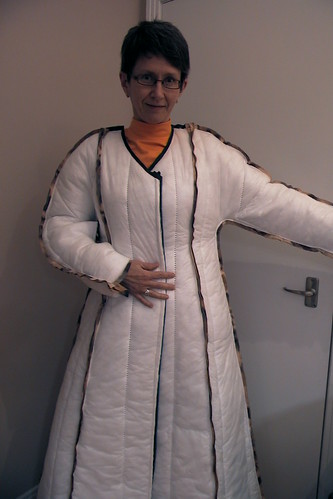 My husband says my latest project, in progress, looks like a cartoon drawing of a coat. Proof is in the picture to the right.
I'm not so troubled by the look - what you see is the Thinsulate, which has been sewn to the lining and facings. It'll be covered by the fashion fabric, once I get further along.
My problem is the fact that the sleeves leave me with virtually no mobility. The depth from shoulder point to underarm is about 11" (28cm) which is FAR too much. The arm parts from the body just a bit higher than my bottom rib. Methinks I will have to insert a gusset. This does NOT make me happy!
I'll have to read up on gussets. To free up the sleeve from where it is tethered next to my ribs, I figure I'll need to slice at least 9cm (3.5") up on either side of the underarm seam. I'll first open the seam, figure out the placement for the cut, and sew a line of stitching on either side to anchor the lining fabric and Thinsulate. I'm not looking forward to the sewing of the gusset. I think I'll underline it with something less bulky than the Thinsulate - perhaps some 100 weight Polartec.
What say any of you experts reading this? All advice including references to articles or books will be gratefully received.
Progress - slow, but progress still
I've now washed (cold water) and machine-dried the cotton/bamboo rayon Spoonflower fabric. The original length of 2 yards exactly (72" or 183cm) has shrunk to 69.25" (176cm). That's about 3.8% shrinkage, which seems a fair amount to me. The printed width, post washing, is 51.5" (131cm) - Spoonflower's site says the printable width is 52" so I think it shrank a small amount in width too. That's after pressing it with steam - the unpressed fabric was drawn up so even shorter.
 The other thing that happened in the wash was slight crocking of the flat dark-grey background, as you can see here. I don't mind it as it gives a slight texture to the previously completely unvaried background - makes the grey look more like the rock you would scan for a trilobite fossil.
I wrote that last sentence, and then went looking on Google for pictures of trilobite fossils from this area. My gosh, I was right! Check these out!
 I think I'm going to make it up in a much-used men's casual shirt pattern, the very long out-of-print McCalls 4115.
 The other thing that happened in the wash was slight crocking of the flat dark-grey background, as you can see here. I don't mind it as it gives a slight texture to the previously completely unvaried background - makes the grey look more like the rock you would scan for a trilobite fossil.
I wrote that last sentence, and then went looking on Google for pictures of trilobite fossils from this area. My gosh, I was right! Check these out!

 I think I'm going to make it up in a much-used men's casual shirt pattern, the very long out-of-print McCalls 4115.
Saturday, November 7, 2009
Two Projects
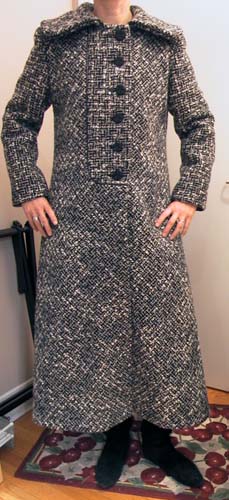
So here are two projects in the queue chez The Sewing Lawyer. The first is my next winter coat. Winter is, they say, coming again this year, and we must Prepare. Today it was below 0 degrees (celsius) so they must be right. I do own several winter coats already. I made a nice wool one last year, taking part in Marji's Great Coat Sew-along. It is very warm. And. Very. Heavy. Despite the fact that it is really not much more than a single layer of fabric (OK, plus a wind-stopping interlining of mystery fabric, and Kasha lining). It was a magnum opus of sorts. I used a vintage Vogue pattern and everything, and it wasn't even my size. Oh, and the pattern would not have made a winter coat that would go over anything more bulky than a light cashmere twinset. So I did have to modify. You can read about my coat project here and here and here and here. For those not interested in the long tale or details, here is my finished coat. Yes, that is heavy wool coating cut on the bias. It really worked!
 This year I thought I'd make a different kind of coat altogether. One that would be presentably elegant, would cover any wardrobe item I might choose to wear in deepest winter, would be warm, but would be L I G H T. This requires abandonment of heavy wool, and the embracing of impermeable synthetic fabrics and Thinsulate!

For my pattern I chose a Burda envelope pattern, number 7731. Like my heavy wool coat, this one is quite long and has a nice easy A-line. It has an interesting collar. Unlike my heavy wool coat, it has no difficult-to-sew details. The sleeves are cut-on. It has princess seams. It does have pockets, unlike the ostentatiously impractical Vogue Couture pattern. And it will not be heavy!
I had a marathon cutting-out session a few weeks ago. But I'm having trouble getting into this project. More to come.
I'm also going to be making men's shirts. I've asked my husband how he would like to be referred to here - he didn't go for "Mr. Sewing Lawyer" so "my husband" he shall remain. Anyhow, he has designed some fabric for himself, which he had printed up at Spoonflower. The motif is trilobites. These ones are from the Ordovician era (488 to 443 million years ago, give or take). In our city (Ottawa, Ontario, Canada), the sedimentary rock was laid down in this time period and fossils of trilobites and other creatures of the time can be found, if one looks carefully.

The fabric is Spoonflower's bamboo and cotton blend rayon ($27US per yard). It's very smooth and nice. I haven't prewashed it yet but will do so and report on shrinkage.
My husband created the image using rubber stamps cut out of gigantic pink erasers. The stamped images were then coloured with chalk pastel and scanned. He manipulated the scanned image using PhotoShop. Stencils were also involved. The resulting print is very attractive, and it's going to be my job to turn it into a truly one-of-a-kind shirt. Stay tuned.
This year I thought I'd make a different kind of coat altogether. One that would be presentably elegant, would cover any wardrobe item I might choose to wear in deepest winter, would be warm, but would be L I G H T. This requires abandonment of heavy wool, and the embracing of impermeable synthetic fabrics and Thinsulate!For my pattern I chose a Burda envelope pattern, number 7731. Like my heavy wool coat, this one is quite long and has a nice easy A-line. It has an interesting collar. Unlike my heavy wool coat, it has no difficult-to-sew details. The sleeves are cut-on. It has princess seams. It does have pockets, unlike the ostentatiously impractical Vogue Couture pattern. And it will not be heavy!
I had a marathon cutting-out session a few weeks ago. But I'm having trouble getting into this project. More to come.
I'm also going to be making men's shirts. I've asked my husband how he would like to be referred to here - he didn't go for "Mr. Sewing Lawyer" so "my husband" he shall remain. Anyhow, he has designed some fabric for himself, which he had printed up at Spoonflower. The motif is trilobites. These ones are from the Ordovician era (488 to 443 million years ago, give or take). In our city (Ottawa, Ontario, Canada), the sedimentary rock was laid down in this time period and fossils of trilobites and other creatures of the time can be found, if one looks carefully.
My husband created the image using rubber stamps cut out of gigantic pink erasers. The stamped images were then coloured with chalk pastel and scanned. He manipulated the scanned image using PhotoShop. Stencils were also involved. The resulting print is very attractive, and it's going to be my job to turn it into a truly one-of-a-kind shirt. Stay tuned.
Tuesday, November 3, 2009
An Amazing Jacket
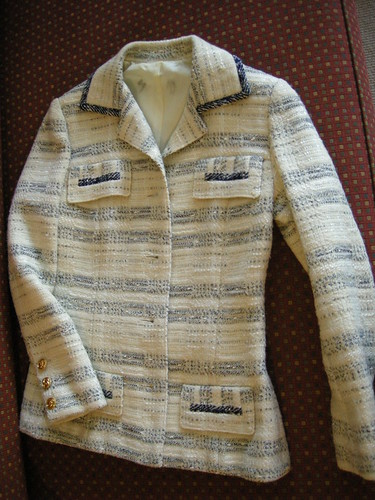 A friend of mine actually likes to shop, and she finds the most astonishing things at thrift shops. Today, I'm going to show you one of her finds. She bought it because it was too good to leave in the store, even though it didn't fit her. I'm the beneficiary and have had the pleasure of owning this jacket for several years. I'm now in the process of replacing the lining, which was shredding. I thought to document the jacket before proceeding.
So, I introduce to you my vintage Auckie Sanft jacket. I can't say exactly when this was made but it was probably the mid-1970s. It is very close fitting and came with a mid-knee length, matching A-line skirt with a plain back and large box-pleated front. The skirt never fit but I have worn the jacket a lot.
Auckie Sanft was a high-quality Montreal manufacturer. Perhaps this jacket was designed by John Warden, though maybe not, as it seems Warden did not work with Auckie Sanft for long. Whoever was responsible for it was a master.
There are several things about this jacket that are special. First, the fabric. This jacket is made from beautiful Linton Tweed. "There has never been a Chanel collection without Linton tweeds", apparently (according to a 2004 story on Scotsman.com News). I believe it! This fabric is absolutely luscious. It's predominantly cream, with novelty threads in silky/shiny white, dark blue and white, and soft grey woven through it to create an irregular plaid. The label says 83% wool, 17% acrylic. From a distance, a little unfortunately, it looks like a horizontally-striped jacket. No matter, it's gorgeous! Here's the back.
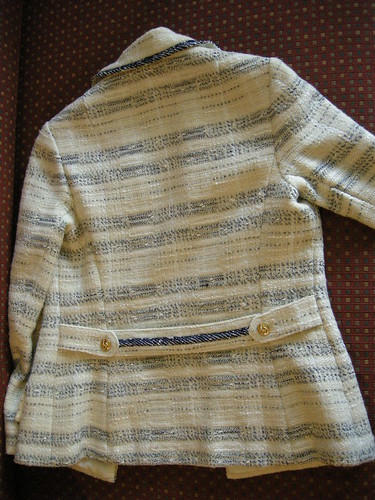
The stripiness of the fabric tells an interesting story. First, it's beautifully matched at all body seams, and the sleeve cap matches perfectly, but only in the back. Hmmmm. In the front, the sleeve cap is not matched to the jacket at the armscye, but the sleeve and body do match lower down.
This is a mystery! The solution is that the upper pocket flap disguises a little seam which does not match. It has something to do with the bust shaping provided by the princess seam.
The designer used what I believe was the darker blue selvedge edge of the fabric to provide a coordinating trim found on the pocket flaps, collar and back belt.
The next feature of the jacket is that the maker has reduced bulk almost everywhere by using lining fabric as facing - the collar, pocket flaps and front are lined to the edge.
There is also very very little internal structure in the jacket. There is a very light shoulder pad and very light-weight and supple canvas (possibly linen?) at the front edges, around the armscye, and behind the pocket flaps. The chest area has a single layer of a slightly stiffer woven interfacing. The back shield and hem interfacing are the softer canvas, cut on the bias. I believe there is no interfacing at all in either the collar or pocket flaps!
Here are some photos of the details.
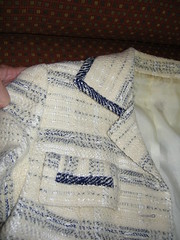

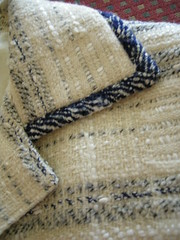
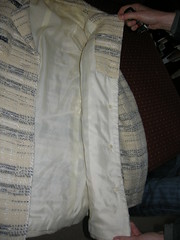
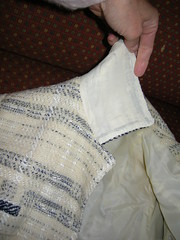
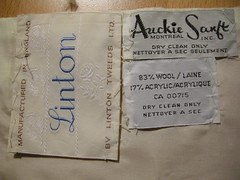
Only the lapel area, sleeve hems and vents are not faced with thin lining fabric. The sleeve hems are bulky! But check out the Chanel buttons. Are they real??
Check out all photos in more detail at my Flickr page.
Monday, November 2, 2009
Obligatory lame first post
I don't really have time for this... But sometimes it may be good to have a place to record what I'm working on.
Sunday, November 1, 2009
Two different views from Illinois and Colorado about business in Panama
http://finance.senate.gov/sitepages/hearings.htm
Statements for the Record: Any individual or organization wanting to present their views for inclusion in the hearing record should submit a typewritten, single-spaced statement, not exceeding 10 pages in length. Title and date of the hearing, and the full name and address of the individual or organization must appear on the first page of the statement.
Statements must be received no later than two weeks following the conclusion of the hearing.
Statements should be mailed (not faxed) to:
Senate Committee on Finance
Attn. Editorial and Document Section
Rm. SD-219
Dirksen Senate Office Bldg.
Washington, DC 20510-6200b
Hearing of the U.S. Senate Committee on Finance On "The U.S.-Panama Trade Promotion Agreement"
Statements should be mailed (not faxed) to:
Senate Committee on Finance
Attn. Editorial and Document Section
Rm. SD-219
Dirksen Senate Office Bldg.
Washington, DC 20510-6200b
Hearing of the U.S. Senate Committee on Finance On "The U.S.-Panama Trade Promotion Agreement"
Thursday, May 21, 2009 10:00 a.m.
215 Dirksen Senate Office Building
Testimony by Mr. James Owens
Chairman and CEO, Caterpillar, Inc. Peoria, Illinois on behalf of the U.S. Chamber of Commerce Business Roundtable and the Latin American Trade Coalition
Caterpillar Washington Office 1425 K Street, NW, Suite 400, Washington, D.C. 20005, (202) 466-0672
Chairman Baucus, Ranking Member Grassley, Members of the Committee:
I’m Jim Owens, Chairman and CEO of Caterpillar, Inc. Today, I have the honor to testify on behalf of the U.S. Chamber of Commerce, Business Roundtable and the Latin American Trade Coalition in support of the U.S.-Panama Trade Promotion Agreement (also known as the Panama TPA or "TPA").
First a word about the organizations that I represent: - Caterpillar is the world-leading producer of construction and mining machines as well as diesel and gas turbine engines. We are also one of America’s largest exporters.
- The U.S. Chamber of Commerce is the world’s largest business federation, representing three million businesses of every size, sector, and region.
- The Business Roundtable is an association of chief executive officers of leading U.S.
companies with $4.5 trillion in annual revenues and more than 10 million employees.
- The 1,200-member strong Latin American Trade Coalition is a broad-based group of U.S. companies, business and agricultural organizations, and local chambers of commerce and other groups representing the largest and most dynamic sectors of our economy.
My company and the business organizations I represent today firmly believe that international trade has a critical role in fostering economic growth for America’s workers, farmers and businesses. The Panama TPA and agreements like it promote sustainable economic growth both here at home and in the economies of our trading partners - in this case a close neighbor and ally, Panama.
The United States has negotiated, signed and implemented successful trade agreements in the Western Hemisphere with Canada, Mexico, Chile, Central America and the Dominican Republic, and Peru. The Panama TPA promises to build on impressive U.S.
export gains in the region.
I’m pleased to report that Caterpillar exports have dramatically benefited from all these free trade agreements (FTAs). Since the FTAs have gone into effect, Cat exports last year quadrupled to the NAFTA countries, tripled to Chile, and nearly doubled to the CAFTA-DR countries.
We believe the Panama agreement will be no exception. The Panama TPA is a frontloaded, ambitious, and comprehensive agreement, with considerable benefits to both the United States and Panama. Most of the tariff cuts on American products will occur as soon as the agreement goes into effect.
The agreement will substantially improve market access for American farm products, consumer and industrial goods, and services in Panama, and it will bolster the rule of law, investor protections, internationally recognized workers’ rights, and transparency and accountability in business and government. The agreement’s strong intellectual property rules and related enforcement provisions will help protect and promote America’s dynamic innovation-based industries and creative artists. The opportunities created by lowering tariff and non-tariff barriers to U.S.-Panama trade and investment promise to expand two-way trade opportunities and lift living standards in both countries.
Beyond the purely commercial benefits, the agreement will also strengthen the century-old U.S.-Panama geostrategic partnership. From the time of the Panama Canal’s construction, the United States and Panama have made common cause on issues from security to commerce. Panama has major ports to both the Atlantic and the Pacific, and the Canal is a major transit point for world trade. With one-third of its population speaking English fluently and a fully dollarized economy, Panama is a good friend and partner of the United States. The TPA offers critical support and stronger ties to this close ally in Latin America, a region where attitudes toward the United States and the values it represents - including democracy, transparency and governmental accountability - have taken a decided turn for the worse in many countries.
In Panama, the May 3 election of Ricardo Martinelli to succeed Martin Torrijos as President of Panama signals a continued commitment to close ties to the United States at a time when a number of countries in the region are taking a different course. President-elect Martinelli has called the TPA his new administration’s "number one priority." Panama’s legislature displayed similar enthusiasm with a strong vote in favor of the TPA shortly after its signing, which incorporated new labor and environmental provisions reflected in the May 10 (2007) Bipartisan Agreement on Trade. Both the Panamanian administration and the legislature have been responsible partners in working to meet the additional requests that have subsequently been raised by the U.S. Congress and administration.
Looking forward, the agreement with Panama is an important step in the U.S. strategy to promote trade liberalization and economic integration with the region. As well as being a gateway from the Pacific to the Atlantic, Panama is a literal and figurative bridge between Central and North America on one end and South America on the other. U.S. total exports to trade agreement partners in the Western Hemisphere reached $471 billion in 2008. This region represents a significant and growing market that has largely avoided the worst of the current economic crisis. We urge Congressional consideration of the trade agreements with Panama and Colombia as the next step in this important strategy.
Opening Markets Above all else, the TPA further opens Panama’s market to products and services made by American workers, farmers, and companies. Panama’s purchases of U.S.
manufactured goods and farm products reached $4.6 billion last year, and the $4.2 billion U.S. merchandise trade surplus with Panama in 2008 was among the largest with any country. Goods exports to Panama from Illinois - where Caterpillar is headquartered - have grown quickly in recent years, surpassing $110 million in 2008, led by rapid growth in exports of machinery.
The United States is far and away Panama’s largest trading partner, with a 33% share of Panama’s imports, and purchasing 36% of all Panamanian exports. The $5.25 billion expansion of the Panama Canal is now moving ahead and presents significant opportunities for U.S. companies to provide goods and services to the government of Panama as they embark on one of the largest public works project since the Three Gorges Dam in China.
We are also excited about construction of a new metro system in Panama City and the Petaquilla mine, which will be the 5th largest copper mine in the world.
The trade agreement will grant U.S. firms outstanding access to the Panamanian market and the chance to compete in selling everything from heavy equipment to engineering services.
U.S. export success in Panama comes despite a fundamental imbalance in the proverbial playing field. The United States unilaterally opened its market to Panama and its neighbors through the Caribbean Basin Initiative in 1983 and expanded that access through successive acts with the support of strong bipartisan majorities in Congress. Currently, under the Caribbean Basin Trade Partnership Act (CBTPA), fully 96% of all imports from Panama already enter the U.S. market duty-free. By contrast, Panama’s average applied duty on imports of manufactured goods is 10%, and agricultural products face even higher tariffs. In other words, Panama enjoys virtually free access to our marketplace, while U.S. products continue to be taxed at steep rates when entering Panama.
The unilateral preferences have always been subject to re-authorization by Congress with no guarantees that they would be continued. Without the extension of these preferential programs, Panama risks immediately losing a significant part of its exports. Losing access to the U.S. market would hurt the Panamanian economy resulting in lost jobs and a lower standard of living.
The TPA makes Panama’s favorable access to our markets permanent and provides additional benefits in the form of improved market functioning and enhanced economic growth. In other words, the TPA will provide continuity in a long-term U.S. policy with regard to Panama - one that boosts economic development and reinforces democratic consolidation.
The TPA will also cut Panama’s tariffs on U.S. products, and as a result it will transform an imbalanced trade relationship into a more mutually beneficial, reciprocal partnership. The day the agreement enters into force, 88% of Panama’s tariffs on U.S.
consumer and industrial goods and a majority of the tariffs on U.S. farm exports will be eliminated. In turn, the agreement locks in Panama’s access to the U.S. market, creating a new level of certainty for investors and traders in that country.
....
The Rule of Law
Intellectual Property: The agreement will strengthen protection and enforcement of U.S. trademarks, patents, and geographic indicators, internet domain names and copyrighted works, creating new opportunities for U.S. innovation-based and creative industries in Panama. In specific terms, the Panama TPA includes strong intellectual property enforcement mechanisms and penalties provisions, including the criminalization of end-user piracy and counterfeiting and the authority to seize and destroy not only counterfeit goods but also the equipment used to produce them. The agreement also provides necessary mechanisms to fight the problem of trans-shipment of counterfeit goods with specific provisions that are aimed at goods-in-transit.
Investment Protections and Dispute Settlement: U.S. direct investors in Panama will benefit from the strong investment chapter in the agreement, particularly the sections dealing with investment protections and dispute settlement. The agreement provides for rights that are consistent with U.S. law and also contains fully transparent dispute settlement procedures that are open to the public and allow interested parties to provide their input. As such, these trade agreements provide an opportunity for the partner countries to improve their investment climate by undertaking legal and judicial reforms and resolving investment disputes (e.g., the criminalization of commercial disputes).
Increased Transparency: The agreement’s dispute settlement mechanisms provide for open public hearings, public access to documents, and the opportunity for third parties to submit views. Transparency in customs operations will aid express delivery shipments, and will require more open and public processes for customs rulings and administration. For customs procedures, Panama committed to publish laws and regulations on the Internet and, to the extent possible, will publish proposed regulations in advance and allow interested parties an opportunity to comment on the proposals. Moreover, transparency in these areas is an essential tool in combating corruption and promoting habits of transparency in government.
...
Like much of Latin America, Central America struggles against corruption, which undermines growth, security, and stability. The Panama TPA contains critical provisions to enhance transparency and accountability in governance, providing the countries with important tools to fight the scourge of corruption. As an example, the agreement provides for the criminalization of bribery in government procurement, providing for better and more efficient procurement on the part of the Panamanian government entities but also affording a more competitive marketplace.
Environmental stewardship has long been a priority for Panamanians as the Canal is dependent on protection of the forests in the huge watershed that allows this engineering marvel to function. The Canal expansion now underway is expected to allow 70% of the fresh water that was previously lost from the locks to be recycled, saving 28-35 million gallons per ship, 40-50 times per day.
The Panama TPA also promotes U.S. security interests by forging a deeper partnership with Panama through a framework for government-to-government relationships that is grounded in the tangible national interests of all parties. Such a framework is vital to enhancing cooperation in numerous areas, including tax information exchange; it also sets an example for other countries around the world as we pursue our global security goals. By promoting economic growth in Panama, the TPA will give a boost to its economy and provide its citizens with long-term growth opportunities.
...
That concludes my remarks. At this time I would be pleased to answer any questions.
Thank you very much.
The Meneren Corporation
4610 South Ulster Street, Suite 150 • Denver, CO 80237 • (303) 221-3369 • Fax (303) 972-8669
7 June 2008
Senate Committee on Finance
Attn. Darci Vetter
Rm. SD-219
Dirksen Senate Office Bldg.
Washington, DC 20510-6200b
Subject: Corruption in Panama, Human Rights Abuse and Trade Agreements
Dear Darci and Committee Members:
I am writing you regarding a serious foreign relations matter regarding the Republic of Panama and the corruption of its legal system and the regular and organized abuse of US Citizens and their civil and human rights—all of which should be considered in any discussion of trade agreements.
I am one of many Colorado businessmen (and a number of CO Corporations and LLC’s) who have been actively doing business in Panama for the past 3 years. During that time, I have witnessed first-hand the extend of the corruption of the Panama legal system, and the systematic robbing of US and Canadian investors (both professionals and retiree’s) by cabals of Panamanian attorney’s, prosecutors, law enforcement officials and other government officials—
all the way to the Supreme Court. I having seen it firsthand and discussed it in detail with the Americans and Canadians who have suffered financially and personally because of it. It is a travesty that should not be rewarded with a Free Trade Agreement of any form.
The most public example of this corruption can be seen in the case of the handling of the estate of Wilson Lucom, a past advisor to the US Secretary of State and his attorney, Richard Lehman, a Florida attorney and US citizen, who has been for 3 years attempting to prevent one of the Panamanian oligarchy’s from stealing the $50+M estate of Wilson Lucom—which Lucom left to the orphans of Panama in the largest ever bequeath of its kind.
The Panamanian government/authorities have relentlessly abused the civil and human rights of Mr. Lehman as he tried to protect the Lucom state, to ensure the money reaches the poor children of Panama and the Charity formed to accept it. This story has received major press coverage in the US and Panama.
You can see the full litany of false charges, false arrests, assaults on the Civil and Human Rights of this US citizen in the documents filed with the Organization of American States, at: http://www.lehmantaxlaw.com/RSL_/62667387_1.PDF http://www.lehmantaxlaw.com/RSL_/62667382_1.PDF
It is important to note that in November 2008 the head of the Panama Governments National Council of Transparency for Corruption, Alma Montenegro de Fletcher, herself published a finding that found “extreme abuse of the Panamanian civil and penal system”, noting the false arrest of a US Citizen who was defending the interests of the children of Panama, Mr. Lehman, a Florida attorney and long time friend and lawyer for Wilson Lucom. The details of Alma’s letter to the Panama Supreme Court can be found at the following (translated) website:
http://translate.google.com/translate?hl=en&sl=es&u=http://www.setransparencia.gob.pa/noticias/noticia_nota_caso_wilson_lucom.htm&ei=kcWVSdqUIoHasAPA1ei4Bw&sa=X&oi=translate&resnum=5&ct=result&prev=/search%3Fq%3D%2522alma%2Bmontenegro%2522%2Blucom%26hl%3Den
To be clear, neither I, nor my business associates are a part of the Probate dispute that Mr. Lehman is battling in Panama. However, when Mr. Lehman was recently detained illegally in Panama—again—I was so upset that a US Citizen could be so abused by the Panamanian government and corrupt legal system that I wrote a “Call to Action” that was circulated among the expatriate community in Panama. As a result, I have received numerous other horror stories from US and Canadian businessmen and retiree’s detailing the systematic pillage of their retirement monies, trust funds, and properties by lawyers acting in concert with local and federal government officials (prosecutors and judges), all with impunity! One of these relates how the Panamanian attorney that stole her retirement monies told her to her face that he robbed her and that there was nothing she could do about it because he was a member of the Panamanian legislature. I would be most happy to share the details of these and other similar cases with you or your staff.
As a businessman, I have done business in many of the ugly parts of the world (Congo, Yemen, Kazakhstan, China etc.) and I understood their corrupt systems before setting foot on the ground. However, Panama holds itself out to US retiree’s and businesses as being a US friendly country that has a US currency, US provided infrastructure and institutions, statutory protections for US Citizens (including a guarantee of “equal access” under the law), and preferential agreements with the US government (FTA’s). US and Canadian citizens are entranced by this façade to make major investments in Panama totally unaware of the extent of corruption of their judiciary and other government officials. This is a recipe for disaster for US interests, and damages the future of the Panamanian people as well.
When we contacted the US Embassy in Panama over a year ago to describe how our firm/project was being manipulated by the corrupt courts and officials, we found a sympathetic ear and could see some effort was being made to press the Government to “clean up their legal system”. Unfortunately, when the Ambassador and key staff changed, the Embassy position turned to one of indifference coupled with a clear desire not to press the issue with the Government. As a result, US Citizens like Mr. Richard Lehman and many others who we have documented, have been, and continue to be abused with impunity.
As a US Citizen, I am shocked that our Government allows this to continue—with impunity and that our Government is willing to turn a blind eye to it by rewarding Panama with a trade agreement that prospers Panama. I ask that you have your staff research the human rights case mentioned and provided above and use it as a symptomatic reason for opposing any further Free Trade Agreements with Panama until it cleans up the corruption. Until then, I also ask that US State Department US Citizen advisories be updated to sternly warn US investors and retiree’s of the escalation in the organized abuse of foreigners by a corrupt judiciary working in concert with unscrupulous lawyers and government officials.
Thank you for your attention to this urgent matter.
William A. Tolbert
President
Senate Finance Committee Hearing on "The U.S. - Panama Trade Promotion Agreement" May 21, 2009 http://finance.senate.gov/hearings/hearing/?id=d88a7f79-c7e0-8ee8-4f2d-226447ffbbe7
Panama FTA will create US jobs http://lawyerfuture.blogspot.com/2009/05/panama-fta-will-create-us-jobs.html
US-Panama Free Trade Links http://www.uspanamatrade.org .
Subscribe to:
Posts (Atom)