Showing posts with label seizure. Show all posts

Friday, April 27, 2012

Homeland Security's Seize and Send Policy on Display at Repatriation Ceremony

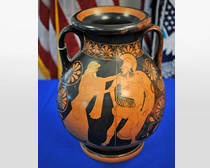
Artifact returned to Italy by ICE.
Courtesy ICE

Immigration and Customs Enforcement (ICE) this week announced successful efforts to combat crime in the United States.  In the last few days, ICE's Homeland Security Investigations (HSI) directorate headlined these results:
  • "9 suspects arrested in HSI probe targeting Fresno-area phony document mills"
  • "637 gang members and associates arrested during Project Nefarious" 
  • "5 indicted for allegedly selling counterfeit goods" 
Yesterday, however, the federal agency announced something other than arrests or indictments.  An April 26, 2012 press release proclaimed, "ICE returns stolen and looted art and antiquities to Italy."

While many of ICE's powerful investigative arms probe violations of federal law and pursue justice through the criminal court system, the Cultural Property, Art and Antiquities Program at HSI continues to repossess artifacts, hold repatriation ceremonies, and ship potential court evidence overseas. Arrests are infrequently announced, and indictments for violating federal smuggling, theft, false statement, or wire transfer laws are rare.

The contrast between ICE's typical approach to cultural property crimes and its customary handling of forfeited documents, human trafficking, counterfeit goods, and other illegal activities is striking.  A few of this week's press releases illustrate:
  • After arresting the nine men for trafficking in forfeiting documents, special agent Clark Settles said that the  "goal in these investigations is to identify and ultimately dismantle the criminal organizations behind these highly lucrative schemes."
  • After 637 gang members and associates were arrested, HSI Executive Associate Director James Dinkins announced that "[t]he goal of Project Nefarious was to identify, locate, arrest, prosecute and remove gang members and associates affiliated with human smuggling and trafficking organizations."
  • After a grand jury indicted five people for selling counterfeit goods, ICE announced that it "plays a leading role in targeting criminal organizations responsible for producing, smuggling and distributing counterfeit products. HSI focuses not only on keeping counterfeit products off our streets, but also on dismantling the criminal organizations behind such illicit activity."
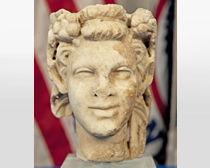
Marble sculpture returned to Italy.
Courtesy ICE
But yesterday's press announcement proclaiming the repatriation of looted and stolen antiquities to Italy simply describes a "ceremony" to return "[t]wo 2,000-year-old ceramic vessels, one Roman marble sculpture, one Renaissance painting and three music sheets from choir books dating back to the 13th century ...."  Authorities did not announce any arrests or indictments despite descriptions of criminal activity by the use of terms such as "looted," "illegally imported," "smuggled," " illicit trafficking," "organized crime," and "stolen."

In other criminal investigations, HSI agents investigate cases, work with prosecutors to develop and sift through evidence, present the results to grand jurors, and hold lawbreakers accountable.  In illegal antiquities trafficking cases, however, Homeland Security Secretary Janet Napolitano said it best during Thursday's ceremony, "We will continue to work to ensure cultural artifacts and treasures that were stolen and entered this country illegally are recovered and returned to their rightful home nations."

This "seize and send" strategy requires rethinking to coincide with the "investigate and indict" mission that other HSI investigations pursue to dismantle and deter criminal activity.

ICE Director John Morton said yesterday that "ICE is serious about reining in art and antiquity thieves, smugglers, and traffickers."  Yet antiquities thieves, smugglers, and traffickers must be brought to trial.  And while ICE poignantly warned in Thursday's press release that anyone "involved in the illicit trafficking of cultural property, art and antiquities can face prison terms of up to 20 years, fines and possible restitution to purchasers of the items," criminals must first be indicted before they can face such consequences in a U.S. district court.  Only then can the "antiquity thieves, smugglers, and traffickers" who are targeted by ICE be held to account for violating federal criminal laws.

CONTACT: www.culturalheritagelawyer.com

Friday, March 30, 2012

Ka Nefer Nefer Case Resumes After Lengthy Hiatus

St. Louis Art Museum
Lawyers for the St. Louis Art Museum (SLAM) filed a sur-reply last week in the case of U.S. v. Mask of Ka Nefer Nefer after activity in the case--at least with regard to legal filings--abruptly ended in August 2011.  SLAM submitted its pleading to the eastern district federal court in Missouri.  The court submission comments on the running dispute about whether the museum has legal standing to remain in the case.

The government filed a claim in March 2011 to forfeit the mask of Ka Nefer Nefer located at SLAM.  The 19th Dynasty Egyptian mummy mask of a noblewoman is alleged by the government to have been stolen from Egypt.

The government's forfeiture action was a response to SLAM's legal effort in February 2011 to quiet the title of the mask so that the museum potentially could own the artifact without worry.  In July 2011, federal lawyers filed a motion to knock SLAM off the forfeiture case, arguing that the museum could make no colorable legal claim to ownership because the mask is a stolen object.  The motion to strike SLAM from the case set off a volley of legal pleadings related to whether the Ka Nefer Nefer mask is contraband.  The federal government argued that possession of the mask was akin to possessing cocaine, which is illegal.

After a long absence of legal submissions, SLAM's most recent sur-reply picks up the argument once again.  The museum charges that it "has consistently taken the position that the Government’s claim is barred from the outset by the statute of limitations and that its forfeiture claim must fail because the Government is unable to prove the Mask was stolen. In raising the arguments it does, the Government is attempting to delay or avoid the consideration of those questions by confusing the standard for constitutional standing and making the bizarre suggestion that the Court pretend that the Museum claims an interest 'not of a centuries old Egyptian mask, but rather a kilogram of cocaine.'  In doing so, the Government so muddles and confuses the term 'contraband,' and the significance that the term carries, that some clarification is necessary." (citations omitted).

SLAM adds that the mummy mask is not contraband per se (such as illegal drugs) "as [artifacts] may be lawfully owned and become contraband only based on a connection with a criminal act."  Relying on U.S. v. Jeffers, 342 U.S. 48, 52-54 (1951), the museum asserts that "[t]he Supreme Court has recognized that, in the absence of a law foreclosing property rights, artifacts can be privately owned."

SLAM criticizes the government, saying that "[t]he Government’s evolving positions with respect to the ownership issue seem to be at war with themselves."  The museum argues that Egypt's patrimony law, which claims ownership of cultural objects found on its soil, is argued by the government to be a law granting private ownership in one pleading and alternatively, in another pleading,  a law that restricts private ownership.

SLAM concludes by reasserting that it has made a colorable claim to ownership to the mummy mask.

The government filed papers on March 28, 2012 for leave to reply to the sur-reply.

CONTACT: http://www.culturalheritagelawyer.com/

Friday, January 6, 2012

Court Forfeits Cristo Portacroce After Italy Does Not File A Claim

The forfeited Cristo Portacroce.
Courtesy ICE
The United States District Court for the Northern District of Florida has ordered the forfeiture of the painting, the Cristo Portacroce Trascinato Da Un Manigoldo.  The court issued the default judgment once the previous possessors, Italy and its Brera Art Gallery, failed to make a claim for the return of the artwork.

The court's ruling was brief:  "Upon Application of the Plaintiff(s) in the above styled cause and having examined the records and there appearing to be no responsive pleadings filed by the defendant(s), default is hereby entered against the Italian Republic, Ministry of Culture, and the Pinacoteca di Brera, on January 3, 2012."

The painting will likely be handed over to the heirs of Federico Gentili di Giuseppe, who filed a claim on December 14, 2011 arguing that they were the lawful owners.  Prosecutors submitted information to the court that the painting was taken from the family by the Nazis during World War II.  Click here for details.

Federal officials seized the Cristo Portacroce in November 2011, which the Mary Brogan Museum of Art and Science in Florida had on loan.  See here for background.

Court papers filed by government lawyers show that the Italian's were aware that the painting's ownership was in dispute.  But the records do not explain why the Italy-Brogan loan agreement did not contemplate legal protection from seizure under the federal law known as Immunity from Seizure Under Judicial Process of Cultural Objects Imported for Temporary Exhibition or Display.

Saturday, November 5, 2011

ICE Seizes Stolen Art From Florida's Brogan Museum - Said To Be Taken During WWII

ICE seizes Romano painting said to be stolen by the Nazis.  Photo courtesy of ICE
Immigration and Customs Enforcement (ICE) officials in Tallahassee, Florida yesterday served a seizure warrant on "Christ Carrying the Cross Dragged by a Rascal."  The painting had been held at the Mary Brogan Museum of Art and Science at the request of the US Attorney's office, northern district of Florida, while prosecutors determined whether the painting by Girolamo Romano’s was unlawfully taken from a Jewish family during World War II.  Now the artwork is now in federal custody.

Who will have final title and possession of the artwork ultimately will be determined by a federal district court judge.

[UPDATE: November 9, 2011 - Read more details here.]

Find the complete press release describing the seizure and issued by ICE here.  Also, listen to Chucha Barber, the Brogan Museum’s chief executive officer, who provides a short audio sketch of the ownership claims to the painting on PRI's The World.

Thanks go to Gary Nurkin for alerting me to this news.

Friday, August 26, 2011

Commentary on SLAM Mummy Mask Case - Proceeds Contraband and Statute of Limitations

The current civil litigation surrounding whether the Ka-Nefer-Nefer mummy mask is contraband is worth following given the current legal arguments in play.

The mask, located at the St. Louis Art Museum (SLAM), is claimed by the federal government to be contraband, which is always unlawful to possess. SLAM, meanwhile, argues that the mask, if it is contraband, must be considered derivative contraband, compelling the government to prove that the mask was utilized in the commission of a crime.

It is open to discussion whether the mummy mask fits into the same category as contraband like illegal narcotics. It is also remarkable to think of the mummy mask as derivative contraband like a car used in illegal gun running. It may be that both legal theories are inexact.

The mummy mask might be categorized as proceeds or fruits instead.

Broadly speaking, criminal search and seizure law categorizes property as fruits, instrumentalities, or contraband. Fruits of a crime are the proceeds of a criminal transaction. These items are ones connected with a criminal act and may be seized. Instrumentalities are objects used to facilitate a crime, and these too may be seized. Contraband items are ones that are plainly unlawful to possess like counterfeit money, and these too may be seized.

In the realm of civil forfeiture of property, particularly dealing with items alleged to be connected to a crime, these criminal law concepts of fruits, instrumentalities, and contraband may be translated into three legal theories: proceeds forfeiture, instrumentalities forfeiture, and contraband forfeiture. If contraband forfeiture is the argument of the government, and instrumentalities forfeiture is the argument of the museum, will proceeds forfeiture be considered by the court? We shall see.

Meanwhile, SLAM’s assertion that the statute of limitations has expired in this case, preventing the government from pursuing its court action, is an argument worth watching closely. Statute of limitations is always an issue of importance when applied to cases of fine art and cultural heritage. In the Ka-Nefer-Nefer mummy mask case, it should be noted that the statute of limitations would not likely apply if the mummy mask is categorized as contraband per se. That is because it would be unlawful to possess the mask under any circumstance at any time. And that is perhaps one reason why the government hopes to characterize the mask as contraband, because it could potentially steer the case away from litigation over the statute of limitations altogether.

We look forward to further developments.

DISCLAIMER: The information provided here is general information only, not legal advice, and not guaranteed to be current, correct, or complete. No attorney-client relationship is formed, and no express or implied warranty is given. Links or references to outside sources are not endorsements. This site may be considered attorney advertising by some jurisdictions. The attorney is licensed in NH. The attorney is not certified by the TX Board of Legal Specialization, nor certified by NY regulators as a so-called "specialist" or "expert." Do not send confidential communications through this site. Contact information may be found at www.culturalheritagelawyer.com.

Wednesday, August 24, 2011

SLAM Disputes Government's "Contraband" Claim in Ka-Nefer-Nefer Mummy Mask Case

In the latest round of legal papers filed in the case of United States v. Mask of Ka-Nefer-Nefer, the St. Louis Art Museum (SLAM) says that its possession of the ancient Egyptian mummy mask cannot be likened to possession of cocaine as the US government's lawyers claim. (See July 31, 2011 blog post for background.)

SLAM's attorneys describe two kinds of contraband. They explain that there is contraband per se, which include items illegal to possess under any circumstance (author's note: think of counterfeit money) and which can be automatically confiscated by the government without a hearing. They also say that there is derivative contraband, which include lawful items that are forfeitable because they are connected with a crime (author's note: think of a car used in drug trafficking). SLAM argues that if the mask is in fact contraband, then it must be characterized as derivative contraband that is not automatically forfeitable. Because the mask is not automatically forfeitable contraband per se, SLAM argues that the government must present evidence that the object is forfeitable as an item that derives from a criminal act.

SLAM writes in its August 3, 2011 pleading (some citations omitted):
"The Government’s evolving positions with respect to the ownership issue seem to be at war with themselves. First, it admitted in its own pleadings that there are several bases under [Egypt’s patrimony] Law No. 215 which would provide for private ownership of artifacts such as the Mask. Now it argues that Egyptian Law No. 215 forecloses property rights in artifacts such as the Mask and renders them contraband per se, akin to cocaine or an illegal whiskey still. In fact, Egyptian Law No. 117, which was enacted in 1983, after Law No. 215, specifically acknowledges that artifacts such as the Mask could be privately owned. United States v. Schultz, 333 F.3d 393, 401-02 (2d Cir. 2003). In that seminal case, the Second Circuit went on to recognize that Law No. 117 was the first Egyptian law declaring illegal any private ownership of all antiquities found in Egypt after 1983. The Mask, therefore, clearly cannot be considered contraband per se in the way that such items as narcotics are intrinsically unlawful to possess."

By making the claim that the mummy mask arguably can be characterized contraband derived from a crime, SLAM tries to reinforce its assertion that the burden of proving the forfeiture is on the government.

Meanwhile, it should be noted that the issue of whether the statute of limitations forecloses the government's seizure action is an argument that SLAM continues to raise. SLAM's lawyers write:
"The Museum has consistently taken the position that the Government’s claim is barred from the outset by the statute of limitations and that its forfeiture claim must fail because the Government is unable to prove the Mask was stolen. In raising the arguments it does, the Government is attempting to delay or avoid the consideration of those questions by confusing the standard for constitutional standing and making the bizarre suggestion that the Court pretend that the Museum claims an interest 'not of a centuries old Egyptian mask, but rather a kilogram of cocaine.'"

The United States Attorney's Office counters SLAM's latest assertions in a pleading filed August 4, saying that SLAM failed to make arguments about the contraband issue when it was supposed to. The government’s lawyers contend that SLAM never before raised the distinction of contraband per se and derivative contraband, writing that the museum only now “disputes whether private ownership of the Mask is authorized under Egyptian law.”

Thursday, August 18, 2011

Seizure of Mexican Figurine Prompts Question of CBP's Legal Authority

United States Customs and Border Protection (CBP) announced in a new(s) release on July 28, 2011 that it seized a Pre-Columbian artifact en route from Indiana to British Columbia. A buyer in Canada reportedly purchased the small orange Nayarit figure of a woman through an auction, and CBP agents intercepted the package in April during routine checks at Chicago's O'Hare Airport. CBP said that the shipment was "manifested as containing an artifact."

CBP and Immigration and Customs Enforcement-Homeland Security Investigations (HSI) had the Chicago Field Museum examine the object, concluding it "to be an authentic Pre-Columbian artifact of West Mexico dating to the early first millennium AD." The Consulate General of Mexico, meanwhile, claimed that the object was unlawfully exported from that country.

CBP seized the four inch tall Nayarit figurine under Title 19, Chapter 14 of the customs laws. The statute is commonly referred to as the Convention on Cultural Property Implementation Act (CPIA), meant to implement the well-known 1970 UNESCO Convention that covers cultural property. Federal agents in Chicago took the ancient Mexican artifact into their possession under Section 2609 of the CPIA, which permits seizure of protected cultural artifacts covered by import regulations promulgated under section 2606 (as well as stolen objects that had been documented in the institutional collection of a state party to the convention). Import restrictions enacted under Section 2606 result when the United States enters into an agreement with another nation under the authority of the CPIA. Many readers of this blog are familiar with the CPIA process and know that several nations have bilateral agreements with the United States pursuant to CPIA. Mexico, however, is not one of those nations.

So how can CBP take away an ancient Mexican cultural object from its possessor by using the CPIA? I called CPB to find out. The agency's representatives were polite and responsive to calls, but the replies were not helpful. A CBP Associate Chief Counsel said that "we don't comment on anything like this," adding that "we limit any of our comments about the law and our interpretation on the law to our client itself, which is, of course, the agency." Such a closed response from a government agency that actively sought public attention to this seizure and freely declared the legal basis for the seizure is unsatisfactory. CBP issued a public press release announcing the taking of the Nayarit figurine and broadcasted that "[t]he artifact will be returned to the Mexican government in an upcoming CBP and ICE-HSI repatriation ceremony." And while the agency claims the matter is under investigation, CBP's desire to return potential evidence to Mexico, coupled with its early public release of information relevant to the case, does not signal a meaningful commitment to maintain the integrity of the investigation.

We are left to speculate about what CBP may have been thinking when it seized the object. Federal officials could not have seized the Mexican artifact under a legal theory involving the National Stolen Property Act because the NSPA requires an item to have a value of $5000 or more before it is considered stolen under that law. The Mexican artifact was purchased at auction for $550, far less than $5000. So CBP had to look for other legal authority to take the artifact into custody.

Perhaps they erringly looked to a treaty for legal authority? The United States and Mexico entered into a Treaty of Cooperation on March 24, 1971, which provides for the recovery and return of stolen archaeological, historical, and cultural properties. The treaty, which is in force today, permits the United States "to employ the legal means at its disposal to recover and return from its territory stolen archaeological, historical and cultural properties that are removed after the date of entry into force of the Treaty from the territory of the requesting Party." But this agreement was not enacted into law under the terms of the CPIA, meaning there are no import restrictions on Mexican cultural property that derive from Section 2606 of the CPIA to justify a Section 2609 seizure of the Nayarit figurine by CBP.

So what exactly was CPB's legal authority to seize the Nayarit figurine? We have no explanation about why a Section 2609 seizure was the proper legal basis to take away the ancient Mexican artifact.

Federal officials must take great care when using unexplained interpretations of the law to promote seizures of property. While CBP may be commended for taking action to detect trafficked cultural heritage, federal authorities should exercise their authority in a reasonable, intelligent, and open fashion. No citizen should be left guessing about how exactly he or she can comply with the law so as to avoid the loss of property. Clear and reasonable applications of the customs laws, and plain explanations to back them, can build public support for America's effort to protect and secure at-risk cultural property. By contrast, offering questionable or undisclosed legal positions in cases where property may be seized—particularly in cases involving potentially innocent possessors—does little to garner confidence in public authorities.

Photo: Chicago CBP

Monday, August 1, 2011

US Claims SLAM Lacks Legal Standing—Asserts That Mummy Mask is Illegal Contraband —Discovery Reveals More Information

In the latest round of papers filed in court last week, lawyers for the US Attorney’s Office in St. Louis sought to strike the St. Louis Art Museum’s legal claim in the federal lawsuit involving the mummy mask of Ka-Nefer-Nefer. Federal authorities sought forfeiture of the mask in March after the museum filed for a declaratory judgment in February seeking quiet title to the artifact. Both cases were filed in federal district court in St. Louis.

Federal attorneys, in their July 27 pleading, contend that SLAM’s “claim of ownership is legally impossible, and as such the Mask is effectively contraband in the hands of the Museum.” The government argues that Egypt’s patrimony law, which gives ownership rights of cultural property to the Egyptians, makes it impossible for the SLAM to own the mummy mask. Therefore, SLAM has no legal standing to assert that it can own the mask.

The government’s brief analogizes SLAM’s claim to the mask as similar to asserting ownership over cocaine—one cannot legally claim ownership. Since the mask cannot be owned by the museum, the museum lacks standing to claim ownership, the government argues.

SLAM says that it has standing to be a legal party in the case because it bought the mask and it possesses it.

The government first disputed SLAM’s legal standing in a July 7 motion. Government attorneys filed the pleading following the receipt of interrogatory answers by SLAM. While the museum wrote that it objected to having to answer questions about how it acquired title to the mask or having to identify documents that would support its claim to lawful ownership, SLAM, nevertheless, answered the interrogatories without waving these objections.

The museum supplied the following information:

• It purchased the mummy mask for $499,000 from Phoenix Ancient Art of Geneva, Switzerland around April 3, 1998.

• Phoenix Ancient Art warranted in a purchase and sale agreement that it had title to the mask and could properly transfer title.

• Phoenix provided provenance information to SLAM before the purchase. “According to Phoenix, in or about 1995, it had purchased the Mask from Ms. Zuzi Jelinek, who in or about the early 1960’s, had purchased the Mask from the Kaloterna (or Kaliterna) private collection,” the interrogatory answer relates.

• The museum conducted a provenance investigation to determine if the mask was stolen by contacting INTERPOL, the Missouri Highway Patrol, the Art Loss Register, and the former director of the Museum of Egyptian Antiquities in Cairo, Dr. Mohammed Saleh.

• The museum conducted an investigation through Swiss legal counsel to determine if there were any liens or encumbrances on the mask. No encumbrances were found.

• Swiss legal counsel confirmed Jelinek’s address.

• The museum contacted Dr. Saleh, who advised SLAM to contact another US museum and who did not say that the mask was stolen or “advise the museum against purchasing the Mask.”

SLAM also provided a spreadsheet of 19 documents, which it claims supports the museum’s legal interest in the mummy mask. The documents can be categorized as a purchase agreement, a bill of sale, letters, and emails.

Missing from the documents list is a purchase or sales agreement between Jenilek and Pheonix Ancient Art. SLAM claimed in past court filings that such a transaction would have occurred in 1995. SLAM, nevertheless, includes on the list of documents a 1997 fax from Phoenix that purportedly attaches a letter of provenance from Jenilek.

Also missing from the documents list are shipping papers or import papers describing the mask’s entry into the United States. Import papers generally describe a package’s date of entry, location of entry, country of origin, value, and contents. The court papers suggest that the mummy mask traveled from Switzerland to the United States in 1998, but this information remains unclear. The mask must have been imported into the United States at some time and at a specific point of entry. But the question of whether papers exist documenting the importation of the Egyptian mummy mask, valued at several thousands of dollars, remains unanswered thus far.

Sunday, March 13, 2011

Changing Course: Enhancing Homeland Security's Policy of Seizure and Repatriation with Investigation and Prosecution

Illegal antiquities trafficking is a global business, linked to major transnational crimes such as money laundering. Additionally, cultural property crimes target humanity’s heritage and spirit. In order to successfully tackle crimes against cultural heritage, federal officials must pursue a strategy of investigation and prosecution.

The current policy of seizure and return does not go far enough. To seize a stolen or smuggled artifact at the American border and return it to its country of origin only serves to repatriate the object. Its confiscation and return does little to deter antiquities trafficking since there is minimal consequence to the perpetrators or accomplices. Building legal cases that lead to arrests and prosecutions would provide both specific deterrence and general deterrence.

The seize and return policy maintained by Department of Homeland Security (DHS) recently came into public view when Customs and Border Protection (CPB) and DHS investigators seized two Chinese artifacts illegally crossing America's border at Newark Liberty International Airport around March 3. Eight days later DHS announced the return of fourteen cultural objects to China, many obtained as a result of an enforcement initiative titled Operation Great Wall. The objects repatriated apparently included one of the artifacts seized at Newark Airport, specifically a Tang Dynasty horse. At least four other Chinese cultural objects that were seized in the New York metropolitan area over the past year were returned to China as well.

Typically when law enforcement officials seize the fruits of a crime or contraband they secure the evidence in anticipation of a prosecution. The return of the Tang Dynasty horse sculpture only a few days after federal officials seized it illustrates how smuggled cultural objects are not treated as criminal case evidence. That is to be expected when the primary mission of DHS is to seize and return, not to investigate and prosecute.

US Customs Director Robert Perez articulated this seize and return policy, declaring that federal authorities are "dedicated to intercepting [cultural] items and ensuring their safe return to their rightful owners." DHS’s news release about the repatriation of Chinese artifacts supports this view, highlighting that “2,300 artifacts have been returned to 18 countries since 2007.” While DHS touts the number of seizures and returns of cultural property, its press statement does not boast of any prosecutions or convictions against looters, smugglers, fences, or receivers of illegally stolen or trafficked cultural heritage.

Combating crimes against cultural heritage requires authorities to investigate and prosecute trafficking rings. Effective law enforcement is characterized by thoughtful investigation, careful handling of physical evidence, and assembly of evidence for review and use by prosecutors. While seizing and repatriating illegally smuggled artifacts serves some purpose to curb antiquities trafficking, federal officials cannot be credited with performing a thorough job if this remains the sole accomplishment.

Immigrations and Customs Enforcement investigators and Customs and Border Protection agents are skilled law enforcement officers who are capable of combating antiquities trafficking effectively. We need to call on DHS policymakers to directly engage illegal antiquities networks by adopting a policy of investigation and prosecution that enhances the existing policy of seizure and repatriation.

Sources:
www.ice.gov/news/releases/1103/110311washingtondc.htm

http://articles.cnn.com/2011-03-03/justice/new.jersey.artifacts.seized_1_newark-airport-antiquities-chinese-government?_s=PM:CRIME