Tuesday, March 9, 2010

The Godfather (1972) Directed by Francis Ford Coppola

Astrid:
It is very fascinating to learn that when Godfather was being made the studio and Coppola did not actually think they were making such a classic. In fact Coppola considered making this first film as a compromise on his road to better and more artful films. Also, Al Pacino and Brando almost didn't make it into the cast. The studio found Marlon to be hazardous to the film and Pacino they thought was a too short nobody from New York. I've been reading on this in Biskin's Easy Riders, Raging Bulls.

Watching Godfather is so easy. It has the perfect look and you don't notice that it takes three hours. What should I say about the subject matter then? That somehow it follows logically for Michael to take on the family business. There goes my unwillingness to understand the family values and the murdering. I'm nodding my head.

But my favorite part of Godfather I is the 15 minutes of Michael's life in Sicily. The thick Sicilian accent and the scenery somehow justify everything...The beautiful first wife (who used to make me really jealous somehow) is amazing. There is something so fragile and out of place about her.
Yet, she is very real and I wish there was an alternative version of the film available where Michael just stays in the barren hot country side with her and has many babies. Forget the honor and the Family and eat some more spaghetti with your red wine.

Oh, well. Luckily there is Diane Keaton in America. But what is wrong with her hair in this film?

Nick :
As my father came from Sicily anything Mafia related held a fascination ever since I was in my early teens. I have seen this film at least 30 times. At various times in the past I've just paid extra attention to Marlon Brando's performance. His various twitches and mannerisms round off his warm performance which draws us in. On one occasion I paid extra lip service to the chemistry between the brothers, played by a never better Al Pacino, James Cann, Robert Duvall and the late great John Cazale. How perfectly cast they were. Sometimes I'll just watch the amazing cinematography by Gordon Willis, who actually won a life time achievement award at the dreadful Oscars this year but amazingly was not nominated at the time of the Godfather's release. The brutal assassination has never looked so beautiful. Even when I watch this film and try to focus on a certain aspect, it still completely involves me, the storytelling is so rich.
The Godfather is arguably the point when the Mafia became mainstream. It made Puzo's book more popular, it gave Scorsese a reason to live. This film invented Robert De Niro (at least the sequel confirmed him). This film inspired the greatest ever TV series in The Sopranos. It's infiltrated our Western society unlike any film in recent history has. It's also an adult's film. Coppola used the Family as a conduit to tap into our basic emotions.

Watching The Godfather in 2010 it surprised me how well the film stood up. I know these scenes inside out, yet they seem so fresh. What I noticed this time was how this film has made us want to like pure evil. It has made the audience relate to mass crime and murder. We can muster sympathy for a cold monster like Michael Corleone. These bad men fuck, drink, cook pasta, have affairs, wear the coolest clothes, drive the best looking cars, are affluent, go to church, play with their grandchildren. Marlon Brando's Don Vito Corleone is a cuddly teddy bear by the end. This humanizes the bad guys. They are just like us. This film is glamor. I aspire to have hair like Al Pacino's in this movie. And this amazing film is still getting better.

Still Yes Minister

Surfing the net I discover a link to a classic Yes Minister scene. I have left the following comment:

One thing which causes no end of wonder to those who came to the programme decades after it was first run (myself, for example) is how it manages still to be so topical. In different episodes Hacker grapples with ID cards, Trident renewal, funding of the arts as against funding of sport, bribes to and from Arabian countries with whom Britain is trying to make a buck, bailing out of failed city institutions by the Bank of England, appointments to the EU, honours doled out in return for favours, wastage in the NHS, banning of smoking, and on it goes.

The answer given by the authors, Antony Jay and Jonathan Lynn, is that when writing the scripts the first thing they did was go back to the newspapers of the 1950s and look for things that were still current for them (the 1980s). And it was the same old things that nearly 30 years on are still current today – all the things I mentioned in the previous paragraph and many more besides. I have the feeling that for as long as there is a Britain Yes Minister will be topical.

Friday, March 5, 2010

Logan's Run (1976) Directed by Michael Anderson


Nick :
Aah, Jenny Agutter. I said hello to Jenny Agutter once. It was in a dining room of a Liverpool Hotel. She looked the same as always. That might not mean much to you but since my adolescence Jenny (we're on first name terms) has been the object of much pent up desire. Going further back then Liverpool in the mid-90's I always remember being at school and the word went out amongst school friends that we should watch Walkabout (Roeg's film about 2 school kids lost in the Australian bush). My father and me at age 13 watched Jenny frolicking naked in the outback! It must be an English thing, but Jenny was a genuine British sex symbol. From the innocence of the Railway Children to the shower scene in An American Werewolf in London Jenny has usually been more interesting than the films she stars in. Safe to say the director of Logun's Run has Jenny near naked on a couple of occasions. It must have been written in all her contracts : remove clothes.
Logun's Run is Sci-Fi 70's style. It's the 23rd Century and the ideology of society is based on pleasure. Everyone lives in a Dome City till the age of 30, then face renewal (which really means death but no one realizes). Logan is a Sandman, who kills runners (runners being people who reach 3o but refuse renewal so they run). One day Logan goes for a briefing with a computer and finds out that renewal does not happen, people just die and it's all been a big con. He is given a mission to go outside the dome to find Sanctuary (a mythical name for outside) and destroy it. He loses four years of his time left and becomes a runner. Logan is played by Michael York who resembles a public school Nazi. Agutter plays Jessica 6 who is in touch with the underground and helps Logan escape the Dome City to the outside. They are both chased by Logan's fellow Sandman and best friend Francis (played by a good Richard Jordan).
All one can really say about this film is it's terrible. It's a great idea, with a condescending script that has to spell everything out in case we don't understand the most basic language.
The effects are bad, the sets move, Anderson directs with the pace of a snail. Peter Ustinov plays the only old man left and even he hams it up. Of course the future is depicted with the fashion sense of Studio 54. Jerry Goldsmith's score is analogue synth heaven. Yet, despite all these problems, this is enjoyable fun. Someone should re-make this with some edge. But still, we'll always have Jenny.....aah.

Astrid:
Logan's Run is another one of those movies that Nick insists on watching by using the punch line: -You'll like this one! Usually it is a lame attempt to convince me to watch something that I most certainly won't care for, but Nick has a history with. Yeah, in this case it was Jenny Agutter, who does absolutely nothing for me.

Although Logan's Run is a pathetic movie as far as acting, script and dramatic tension goes, it looks great. the 1970's vision of the future is groovy and colorful. Also, the novel behind the movie script is probably full of fascinating propositions. The idea of a future community without any manual labor left to do, just hedonism and death at 30 (to cut down over-population) sounds inspiring to begin with. The question of bringing up children without any biological parent contact is another interesting thought, but for this film it is simply something awful to frown upon. Killing other people, such as Runners who attempt to continue life after 30, has been made to look like renewal and/or is done by robots. This removal of human empathy in a society must be a central theme in the novel. In the film such crucial visions of the future play only a small part as the thematic backdrop for Jessica's and Logan's boring escape into the real planet earth outside the dome.

Wednesday, March 3, 2010

The Grifters (1990) Directed by Stephen Frears


Nick :
The memory is deceptive. Mine certainly is. I'm constantly re-watching films that at sometime I thought were really good but now disappoint. It's almost the same with the Grifters.
Based on Jim Thompson's novel, The Grifters is a modern Noir, a Grifter being a con man. John Cusack plays a conman who is torn between his rarely seen mother (working for the mob placing bets on horse races) and his latest girlfriend (a former big time con artist, who pays bills with sexual favors and is looking for a new con man partner).
Frears shoots this film with a slow pace, only the last act does the picture start to grip. It also looks very early 90's, which is to say it looks like a made for TV movie . Cusack is a little too frat boy and stiff to convince as the con man Roy Dillon. But what makes The Grifters almost classic are the two women who lead this film.

The Grifters was a calling card for both Anjelica Huston and Annette Bening. Bening is very sexy, naked (I have her breasts implanted in my memory you see them so often in this picture) and playful as the crooked girlfriend Myra Langtry. She spews some great lines like "he was so crooked he ate his soup with a corkscrew" and her performance adds the energy the film lacks because of Frears direction. A career defining turn.

But Huston is the one to watch. Lurid outfits, bleached blonde hair, her personality and quirky character engulf this film. The heavy suggestion of insest between Roy Dillon and his mother Lilly only convinces because of Huston's seedy sexuality. So long in the shadow of father John and Boyfriend Jack (Nicholson) this is where Anjelica shows us what we've been missing.Don't fuck with Anjelica, she'll rip your balls off. Her acting in the tragic final act is humane and believable. In that scene we get the heart of this film.

Ultimately, one can only wonder what the film's producer, Martin Scorsese would have made with such strong material. And why has Anjelica Huston not had more roles like this. Ice Baby Ice.

Astrid:
The idea of Grifters is better than the movie itself. Somehow it did not manage to involve me emotionally, so I didn't really care for the mother who ends up killing her own son even.
John Cusack is completely wrong for this film. He is supposed to be the son of a mafia bet maker who had him at 14. So, he should be on the edge and wired. He's supposed to be involved in 'big con', a good bluffer, but who would believe that Cusack is even acting. (Looks like he's asleep here.)

On to Annette Bening: Dressed in figure hugging 80's outfits (usually in mustard) Bening plays a sexy trickster who's willing to go to any length for wads of dollars. (This is Annette before she married Warren Beatty.) I can see that this was a fun role to play and that as an actress she was willing to do anything for the best of the movie (run around naked).

There is a kind of ragged charm to this film and the women steal the show from the get go. Also, the early 90's film noir-look is reaching coolness.

Tuesday, March 2, 2010

The Towering Inferno (1974) Directed by John Guillermin & Irwin Allen

Nick:
This film is so long. I went to see this on release when I was 8 years old and I always remember the interval. It was at the most exciting part of the film where a stairwell explodes and Paul Newman is left hanging from some mangled metal. That's as good as it gets. I'm a sucker for disaster movies, I love them and it's possible this is the king of the genre. Observations on this film : it's terrible, slow, script is rubbish, it even manages to look bad which is nigh on impossible for a picture made in 1974. The first hour is water torture. Then the fire starts and you can try and watch which famous 70's actor make it through the smoke and ruble.
It's the tallest building in the world and it's the opening party. William Holden built it, but not before he cut costs and ignored architect Paul Newman's specific safety mandate, the result: FIRE.
The party to celebrate the building is on the top floor so the race is on to save the party goers from being burnt to death. There really is no way out! Aren't you tense?
Steve McQueen plays the fire chief who is practical. You somehow realize that McQueen must have been really stoned when he made this one, it's in those glazed blue eyes. It's macho testosterone time as the biggest movie stars of the era trade heroics. Newman does a lot of action in this while McQueen organizes a lot and talks on the phone.
Faye Dunaway is the sexy journalist who can't decide to stay with Newman, almost reprising her Network role. Selznick's old squeeze Jennifer Jones has a date with con man Fred Astaire (he has a geriatric dance in one scene). OJ Simpson saves a cat from fire. It's a soap baby.
Could The Towering Inferno be the ultimate 9/11 movie? It's certainly better than Stone's World Trade Center and Greengrass's fictional United 93. It's hard not to make the comparison even though this is pre 9/11.
So, this film is bad, bad bad, yet.....nostalgia for my youth wipes out my critical faculties. It's Sunday afternoon, it's raining/hurricane is raging outside guff, I've watched every other film going, kind of fare. "Watch Out! This movie blows!!"

Monday, March 1, 2010

Let The Right One In (2008) directed by Tomas Alfredson

Astrid:
Let The Right One In has been sitting on our shelf unwrapped for some time now. It's a vampire movie and therefore, I decided, too scary to watch in the evening. Yes, there is blood, people hung in trees, murder and infection, but none of it feels unreasonable after all.

The main characters Oskar and Eli (the vampire), both about 12 years old, are like a modern day Ronja and Birk of Swedish story telling. This film is a beautiful fairytale about what it means to become friends. The facts that Eli needs to eat blood to live, avoid sun light, and that she can crawl up walls and fly, are only minor details and the things that make her vulnerable and special.

Oskar is badly bullied in school. The depiction of bullying and the cruel dynamic in which he tries not to lose sense of self-worth is shockingly life like. Unfortunately. In the end the bullies threaten to kill Oskar. But luckily he has one friend, Eli.

In the Swedish suburban setting the movie also manages to address single motherhood, divorce, and alcoholism. Serious and re-occuring themes in Scandinavian families, for real. But despite the somewhat depressing content, Let The Right One In is full of hope. The mixture of fantastical, unreal, realist and historical is so inspiring that I wish school children could watch this. It's too gory for them, I know, but the child in me was thankful to see an emphatic and understanding film about growing up. It's the hardest part.

Nick :
It's weird watching a vampire film set in such common surroundings. The buildings, deep snow and aesthetics of Alfredson's film felt so much like suburban Finland at times, even though it's Sweden. Let The Right One In had a similar portrayal of vampire needs than Bret Easton Ellis' short story on LA vampires from The Informers. Maybe it's the everyday need for blood that's so matter of fact in both stories that I think binds them, even though they are so different.

Two children, both 12, become good friends. Oskar has divorced parents, no friends and is bullied at school. Eli, has been 12 for many years. She can fly and is a vampire with a constant need for food (i.e. blood). Oskar and Eli inevitably fall in love whilst Eli helps Oskar confront and gain revenge on his tormentors. Despite the Horror genre, what makes Let The Right One In so effective and touching a movie is the focus on the friendship between Oskar and Eli. Alfredson's film is high on atmosphere and looks amazing, almost idealizing the Swedish winter. There are some vampire cliches thrown around this film. Stay out of the daylight, the sight of blood making Eli crave for Oskar's blood at one point, the flying and Eli's attacks on her victims. But all this is handled with a deadpan beauty and naturalism that seems refreshing rather than stale.
This film moved me in some strange way. I didn't find it scary or anything like that, but Eli and Oskar's friendship was a good one to watch blossom. Chilling and poetic in an unpretentious way.

Pressing equipment

They say, with good reason, that when sewing you should spend almost as much time at the ironing board as at the sewing machine.  A garment whose seams, darts and edges have not been properly pressed just screams "homemade", and not in a good way.

So I thought I'd show you my pressing equipment.

Until about 10 years ago I sewed with the help of what I thought was a pretty good iron - a T-fal.  Since acquiring my first "serious" iron, a steam generator, however, I've never looked back. Having a great iron and learning how to use it, and some specialized pressing equipment, kicked my sewing up to a higher level. 

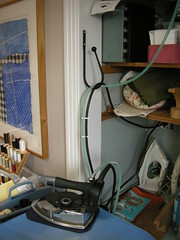
Pictured to the right is my Euro Pro steam generator iron.  This iron is no longer made.  Other brands now available include Reliable, Rowenta, and DeLonghi.  There are probably lots more.  I paid about $300 for my Euro Pro and it's about 5 years old.

The downside of a steam generator is that it takes longer to get to full heat, and it draws a lot of power.  This is because you are heating the water in the tank, as well as the sole plate of the iron.  Once it's up to full heat, you have unlimited steam until the tank is empty.  Unlike a household iron, the iron does not steam when you hold it horizontal; rather it steams when you press the button at the front end of the handle.  On my Euro Pro you can lock the steam button down, but I always found it better to press the button only when I needed the steam.

I had an ironing crisis one day about a year ago when the Euro Pro would not turn on - it needed a new switch.  In the meantime, I needed an iron!  I headed to Cornwall, Ontario, to Giroux Sewing Centre, after realizing they could fix my iron, and that they sold gravity feeds.

I bought a Consew Silver Star ES-300 which is now my sewing room workhorse.  My Euro Pro is relegated to back-up.  The gravity feed system relies on the flow of water from a plastic bottle to the hot iron.  It is a lot heavier than the iron part of the steam generator, about 5lbs. It heats up as quickly as a standard household iron. 

I love the shape of it - low and sleek.  The button on the handle is the steam control. 
 Here you can see how I've attached a hook to keep the tubing which carries the water and the cord out of the way. 

Unlike the steam generator, the gravity feed iron produces steam when the water hits the heated sole plate. They say the steam from the steam generator is drier than the steam produced by the gravity feed.  I'm not sure I notice.  What I do notice is that because cool water is hitting the hot sole plate, my gravity feed cannot steam continuously the way the steam generator can. But that's OK - I like my steam in short bursts anyway.

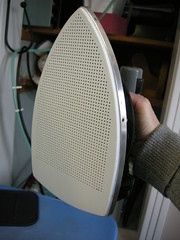
These irons only have a few holes for the steam, near the iron's point.  This is not a problem - you give it a burst of steam, and then use the dry iron to flatten the fibres.

A final point about my iron - it came with a teflon sole plate and I use it all the time.

Now for the ironing board - I have a Reliable C81 Vacuum & Up Air ironing board. This expensive item is an extremely sturdy board with a built in heating element and a fan.  The fan can run in 2 directions - down, which pulls the steam through the fabric and cools the piece quickly, or up, which creates a cushion of air you can iron delicate fabrics on. I'm not 100% sure why it has a heating element (to ensure all the steam drawn down inside evaporates, perhaps?) but the fan is great for tailoring or sewing with wool. 

Next up are my pressing tools.

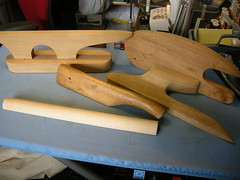
I have a good selection of wooden pressing tools which you can see in the next picture.

At upper left is my Dritz point presser and clapper (they call it a "pounding block").  At upper right is my tailor board (made by my husband).  In the middle is an antique mallet of some kind which can double as a really menacing clapper, and in front is a wood seam stick. 

One uses wood because it gives a very hard and flat surface for flattening seams - the clapper is for convincing the wool to STAY flat!
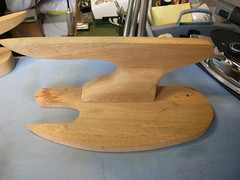
Of these tools, the most-used is my tailor board.  Here is is with its straight side up.  Both sides have a point presser.  These are great for pressing open the seam attaching the facing to the jacket front and lapels, or the upper and under collar.  The narrow wood edges are easy to get into fairly confined spaces.

I also use the seam stick a fair bit - it's essentially a dowel with a flat side so it doesn't roll around.  Pressing a long straight seam open against the seam stick avoids any risk of the seam allowances imprinting on the garment, since the curved edge means that if you press on the stitching line, there is essentially no pressure between the iron and the seam anywhere else.

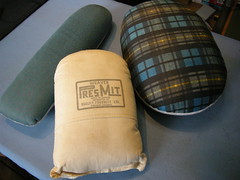
Then there are the hams.  These are all commercially-made.  The long sleeve roll to the left is very good for inside any tubular item - sleeves and pants.  It does the same kind of job as the seam stick but is softer.

The standard shaped ham is very good for pressing open seams with a curve, such as at the hip, or for darts.  It basically gives you a curved ironing board so you don't flatten the shape that has been stitched into the garment.

The PresMit is much softer.  You slide your hand into the pocket (you can see the edge of it below the label), and then you can place your padded hand right inside a garment (i.e. inside the shoulder) and press against your hand, without burning yourself.  I inherited this specimen from my sewing grandmother, along with her Featherweight and a few other choice items.

You can also make your own pressing hams.  I made the strangely-shaped one pictured here.  I wish I could remember where I found the pattern - perhaps in an old issue of Threads?  The idea of this one is that it has a number of different curves, and you can even use it to press open a fish-eye dart since the curves of the ham (sort of) have a waist indent.  I made this so long ago I cannot remember if it is a double-layer casing, but I suspect it is since it hasn't lost any stuffing.  On the subject of stuffing, I used sawdust, and could have used more - it's a little on the soft side. 

Finally in this picture, you can see two tools for pressing velvet (not that I've actually made a velvet garment) - a velvet board approximately 4"x8" (10x20cm) and a generous piece of mohair velvet upholstery fabric.  I picked up the velvet board at the Fabric Flea Market which is why it's so full of lint - I guess its previous owner made a ton of items from cotton velveteen in all colours.

And then the silk organza press cloth - I just cut off a generous rectangle and serged the edges.  It's terrific because you can see through it.  

If I ever make any progress on my actual sewing, I'll show these in action. In the meantime if you have questions, post them in the comments.